

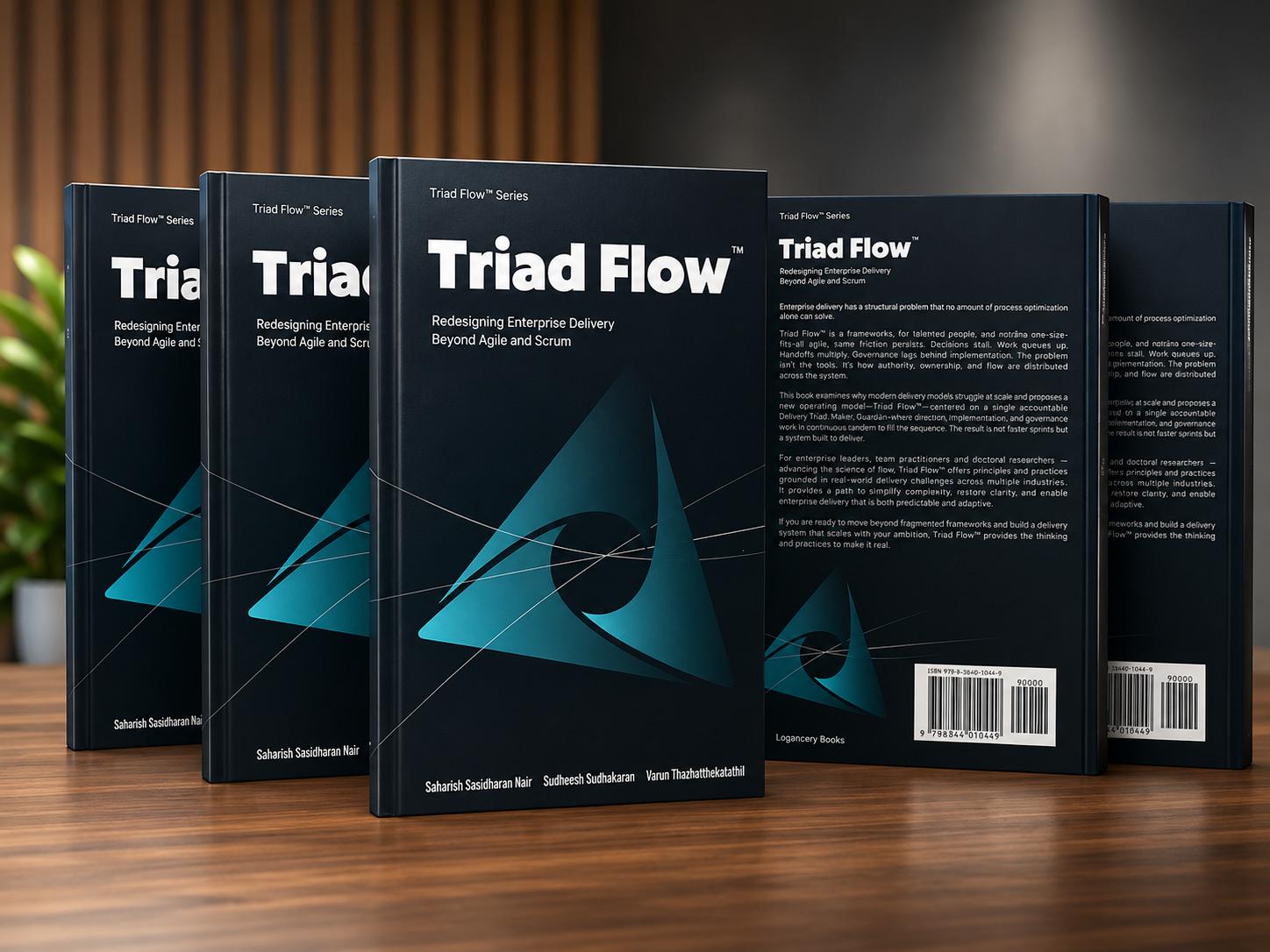

A conversation with Sabarish Sasidharan Nair, Varun Thazhathekalathil, and Sudheesh Sudhakaran — the practitioner-researchers behind Triad Flow™ — on the hidden cost of coordination, the Driver–Maker–Guardian model, and why AI makes the problem urgent.
Three technology leaders spent years watching capable teams stall inside well-run organizations. Their diagnosis — that enterprise delivery fails for structural rather than human reasons — became Triad Flow™: Redesigning Enterprise Delivery Beyond Agile and Scrum (Legacy Books), the first in a planned four-book series. We sat down with the authors to unpack the idea and why they think it matters now.
Q. Let’s start simply. What problem does Triad Flow set out to solve?
Sabarish Sasidharan Nair: The one every senior leader recognizes but struggles to name. You add headcount, you buy better tools, you mature your process — and the time from idea to customer gets longer, not shorter. For years we assumed that meant we were executing badly. It doesn’t. It means the structure itself is working against us. Triad Flow is our attempt to fix the structure rather than pile on more process.
Q. You use the phrase ‘the coordination tax.’ What is it?
Sabarish Sasidharan Nair: Every piece of work costs two things: the effort to build it, and the effort to coordinate it — aligning, negotiating, approving, waiting. In a small team, coordination is almost free. At enterprise scale it inverts. When we measured it across twelve organizations, coordination cost exceeded execution cost in ten of them, with a median of roughly two-to-one. People are spending more of the week coordinating the work than doing it. That tax is invisible on most dashboards, which is exactly why it persists.
Q. The heart of the book is the ‘Execution Triad.’ Why three roles?
Sabarish Sasidharan Nair: Because every delivery decision is really one of three questions: what should we build, how should we build it, and is it safe to ship. We give each question a single owner — the Driver, the Maker, and the Guardian. Three is the minimum that keeps each check independent, and the maximum before you start fragmenting authority again. Fewer than three and something essential collapses; more than three and you’ve reinvented the committee.
Q. Skeptics will say this is just Scrum with new labels — Product Owner, tech lead, QA. Is it?
Varun Thazhathekalathil: I understand the reflex, but no. The difference is authority, not vocabulary. In most organizations a Product Owner coordinates but can’t actually decide — they still have to negotiate with other owners, wait on an architecture board, route a release through a governance gate. A Driver holds real acceptance authority. The roles in Triad Flow are defined by the decisions they own outright, not by a job title on an org chart. Rename the boxes and change nothing, and you get what we call a zombie role — new title, same waiting.
Q. Governance is where regulated organizations get nervous. You argue against gates. How does that work in a bank or a hospital?
Varun Thazhathekalathil: We’re not arguing against rigor — we’re arguing against queues. Regulation requires evidence and accountability. It does not require that work sit in a line waiting for a reviewer who is underwater. The Guardian owns risk, security, and compliance with real authority and produces the audit trail as the work happens, not weeks later. In practice you keep every control you’re required to have, and you lose the waiting between them. For regulated teams that’s the whole game.
Q. Sudheesh, you led the AI analysis. Why does AI make this more urgent?
Sudheesh Sudhakaran: Because AI removes the one constraint everyone optimized around. When a model can generate working code in minutes, implementation stops being the bottleneck — and the next constraint surfaces immediately. It turns out to be specification quality, the speed of human judgment, and governance capacity. We introduce a term for the first one: specification debt, the gap between what you meant and what you actually specified. AI will happily build the wrong thing quickly and confidently. So the questions Triad Flow assigns — who owns the intent, who exercises judgment, who governs the output — get sharper, not softer.
Q. A memorable line from the book is that work should ‘ship when it’s ready, not when the calendar says so.’ What’s wrong with sprints?
Sudheesh Sudhakaran: Nothing, for the world they were designed for. Time-boxing exists to re-synchronize people whose authority is split — it’s a workaround. Once one unit holds the authority, the calendar stops earning its keep and just adds artificial waiting. A flow cycle is defined by completion. Readiness governs progression, and the Guardian decides when ‘ready’ is true. It’s not about sprinting faster; it’s about removing a constraint you no longer need.
Q. How does an enterprise actually adopt this without a chaotic reorg?
Varun Thazhathekalathil: Never big-bang. The failure data on transformations is brutal — most fail, and they fail at the scaling step. We recommend a pilot-first path: diagnose your baseline, stand up a single triad and genuinely transfer authority to it, prove it moved the numbers, then expand on the evidence. The hardest part isn’t structural, it’s human — you’re asking people to trade familiar roles for new ones. That transition needs real coaching, not a memo.
Q. Is Triad Flow proven, or is it a theory?
Sabarish Sasidharan Nair: Both, honestly, and we’re careful to say so. It’s grounded in our combined experience and in a five-paper research program — a measured coordination tax, a comparison of decision authority across five frameworks, a structural analysis of AI-native delivery. A peer-reviewed journal article is under review. But we present the model as a lens, not a finished proof. We’re explicit in the book about what still needs controlled study. We’d rather be honest about the evidence than oversell it.
Q. Does any of this apply to a ten-person startup?
Sudheesh Sudhakaran: Arguably it matters most there. Startups are fast precisely because coordination is nearly free — they’re below the tax. The danger is scaling and importing a big company’s org chart, turning a one-message decision into five sign-offs. For a startup the roles are hats, not hires: the founder drives, the engineers make, someone owns ‘safe to ship.’ Keep authority consolidated and you keep your speed.
Q. This is book one of four. Where does the series go?
Sabarish Sasidharan Nair: Book one establishes the structure. The next volumes go deeper into AI-native execution, into startups, and into legacy teams — the hardest environments to change. The throughline is the same: execution is becoming the real competitive advantage. Strategy advantages erode fast; the ability to deliver consistently is what lasts.
Q. One thing each of you wants a reader to take away?
Sabarish Sasidharan Nair: If your organization spends more time aligning than building, that’s not a people problem. It’s a structure problem — and structures are human creations you can change.
Varun Thazhathekalathil: Governance can enable speed instead of blocking it. You don’t have to choose between rigor and flow.
Sudheesh Sudhakaran: When building becomes cheap, judgment becomes the advantage. Decide who owns it before your tools force the question.
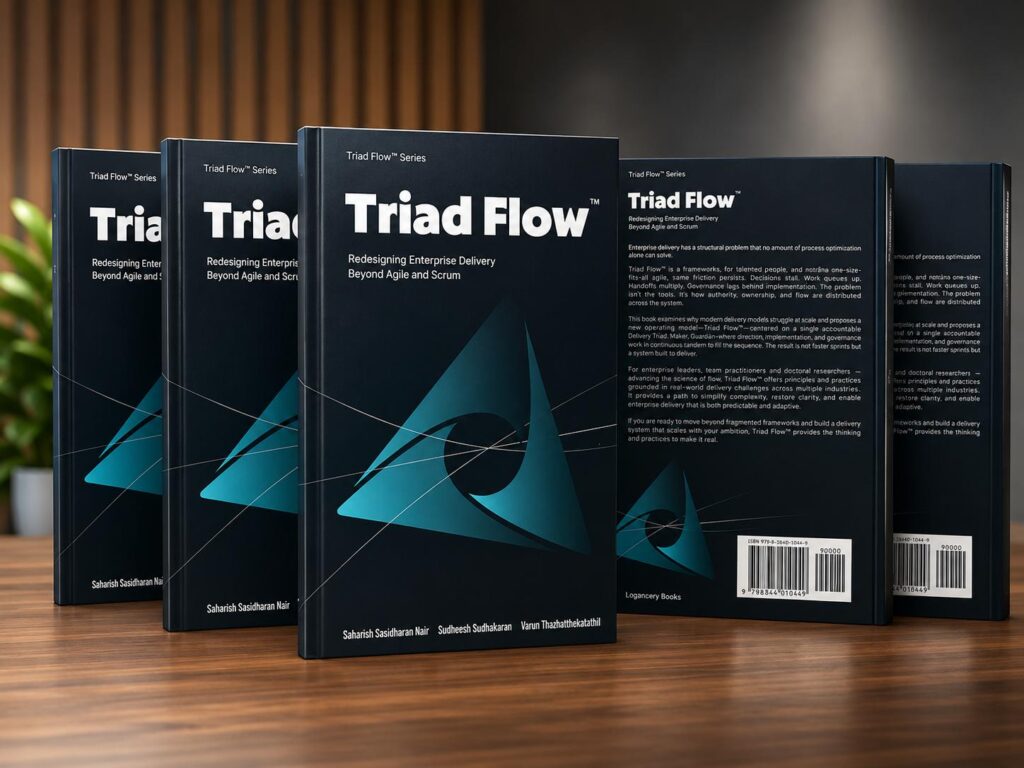
About the book
Triad Flow™: Redesigning Enterprise Delivery Beyond Agile and Scrum is published by Legacy Books and available now on Amazon https://a.co/d/00N2VY0h . It is the first title in a four-book series. Learn more, read an excerpt, and take the self-assessment at https://triadflow.org
About the authors

Sabarish Sasidharan Nair, Varun Thazhathekalathil, and Sudheesh Sudhakaran are enterprise technology practitioners and doctoral researchers with more than forty combined years leading delivery across Fortune 500 organizations. Triad Flow™ is their execution operating model; the concept, terminology, and original expression are their intellectual property.
Our framework link | https://triadflow.org
Amazon Book purchase link | https://a.co/d/0aa0Jj6v


