


Art, business, and architecture: the quiet framework of good work
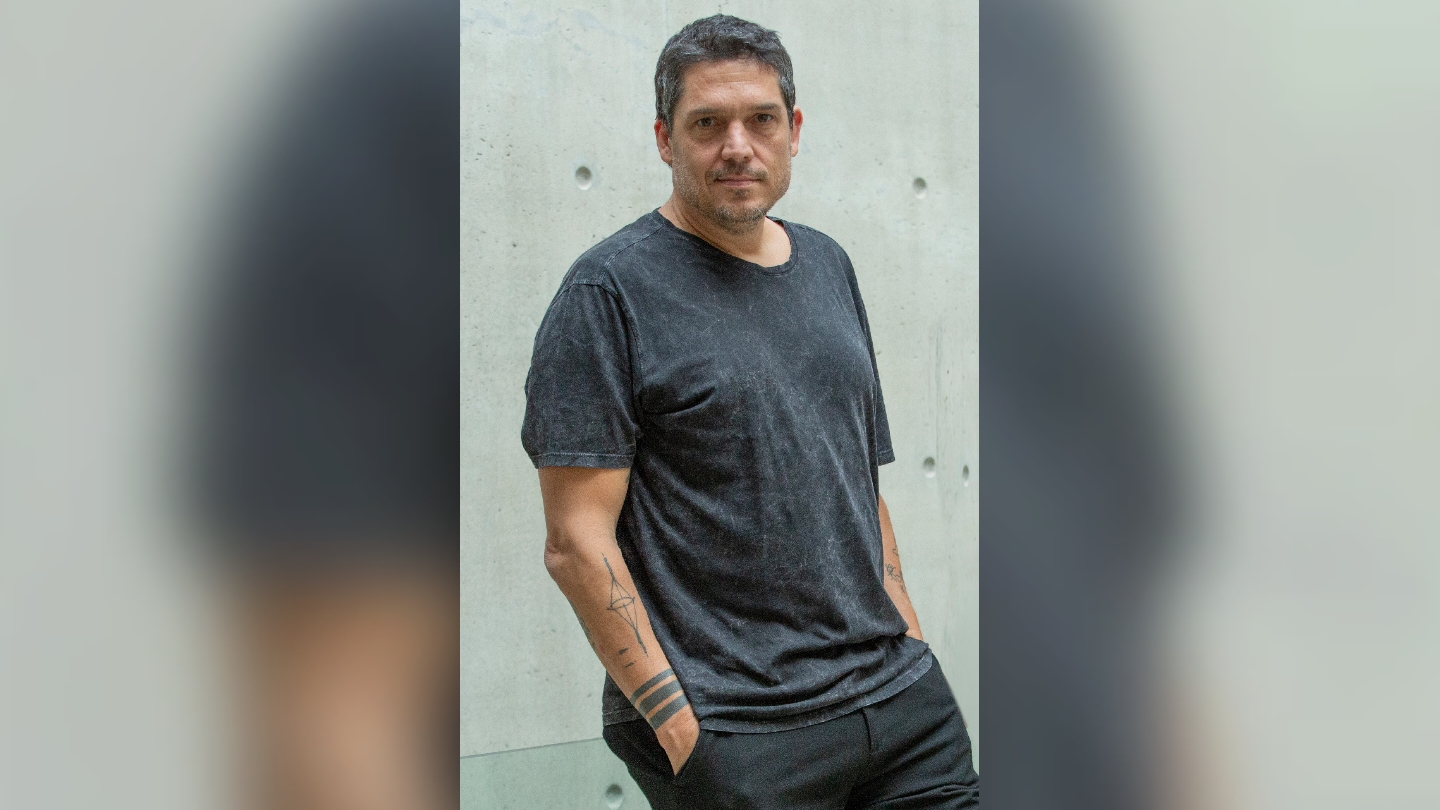
There are architects who draw, others who build, and a few who understand that a project begins long before the first line and ends long after it is handed over. Lisandro Aloi —Argentine architect, university lecturer, musician for years, visual artist, and the representative for Argentina’s chapter in the history of the American Institute of Architects— looks at things from many angles. Founder of SANO (Sociedad de Arquitectura Nómade, the Nomadic Architecture Society), a studio that embraces partnerships with colleagues of different backgrounds and geographies, he moves naturally between the studio, the drafting table, and the negotiating table. For him, art, culture, and business are not opposing worlds but layers of the same creative gesture, and understanding how they interweave is part of the contemporary architect’s craft.
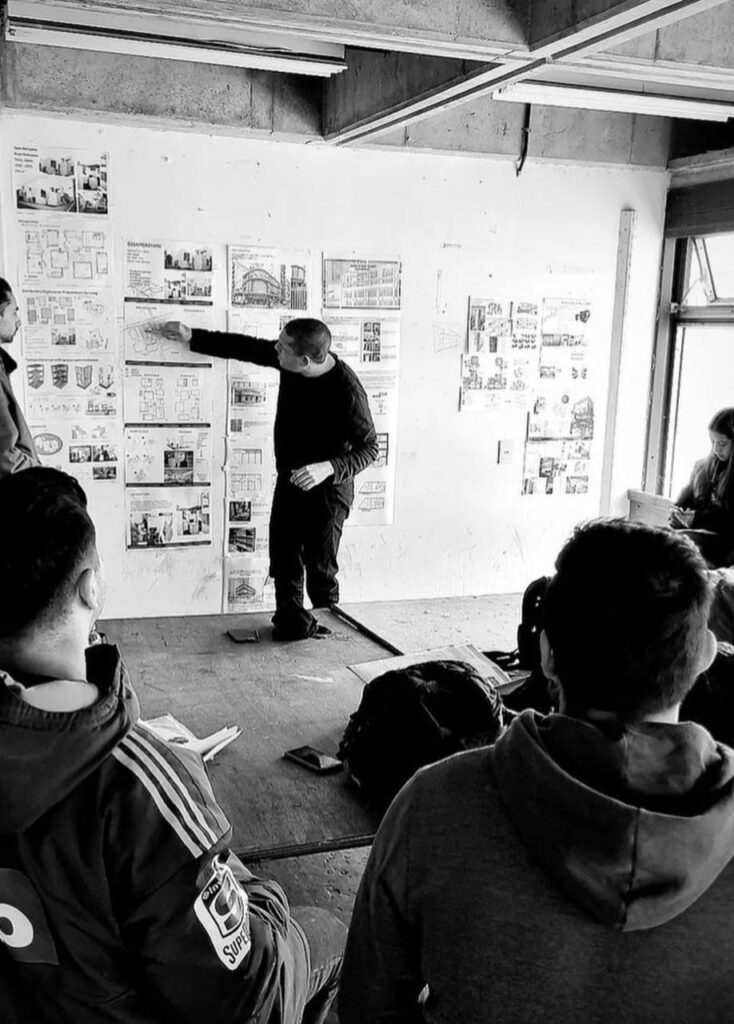
We met him in Buenos Aires, in his studio, surrounded by sketches, books on great masters like Antonio Bonet and Tadao Ando, and models of projects at different stages. He speaks slowly, like someone who has thought hard about every word. And when he finally says them, he does so with the conviction of someone who knows that architecture, properly understood, is a political, economic, and poetic act all at once. We talked about what design magazines almost never cover: architecture as a healthy business, the projects underway, the trips that reshaped his outlook, and the ethical responsibility of those who build the spaces where others will live for decades.
Art, business, and architecture. They’re often presented as opposing worlds. How do you see them?
It’s a triptych… they’re fundamental layers for solving a demand, a need, in a complete, integrated sense. Art, in turn, can be many other things, but that’s another conversation… each of those could open up a whole range of topics. One of the first theorists of architecture, Vitruvius, who wrote the first treatise on architecture in history, in the first century BC, already spoke of Firmitas, Utilitas, Venustas…. That fact alone tells us a lot about this relationship… It’s not a new debate. Architecture without “business” stays on paper; and business without art or architecture becomes pure speculation, buildings that age badly, and neighborhoods or cities that lose their soul and culture. What inspires and endures appears when the three manage to coexist. The work I admire always has those three layers. There’s a deep intention or “voice,” a precise architectural resolution, and an economic logic that makes it possible for that work to exist, to be maintained, and to be valued over time. To pretend you can separate them is a romantic naiveté that practice disproves every day. The architects I respect most understood early on that refusing business doesn’t make them purer — for the most part, it makes them more irrelevant.
Art leads that triptych, and in your case it isn’t an abstract point — you’re also a visual artist. How does art show up in your career?
I’ve been drawing since I was born, I’d say. As a kid, the walls of my room were my first canvas… not always with permission. Later, while I was studying architecture, I also trained at the Argentine School of Photography, and for years I had a parallel career as a photographer: I traveled the world shooting people and cultures for different magazines, alongside documenting cities and buildings as an architectural travel photographer. And from those university years on, I showed that photography and other work in exhibitions, institutions, and galleries. One important one was at MARQ, the Museum of Architecture of Buenos Aires. All of that — the people, the places, the way of looking — is the background I later drew on to build my architectural voice and ideas. But I don’t want to dwell too much on the artistic side, because that’s not where the interesting part is. The interesting part is something else: making a work of art speaks to exactly the same thing as making architecture. It’s about relating a creation to a space, telling a story, an idea… and getting that idea, in turn, to become a beautiful work. Venustas, Vitruvius again. Beautiful so that someone wants it, chooses it, exhibits it; so that it fulfills that full function only art can give us. Once you understand that, drawing, photography, and the project stop being separate disciplines. They’re the same gesture, seen through different windows.
Why do you insist that good business is a condition for good architecture?
Because architecture happens on a piece of land, in an economy, in a culture, with a client, with needs, deadlines, and numbers. If we’re talking about the real estate market, when a project understands its place and its moment, it sells better, it’s lived in better, and it ages better. Efficiency and good architecture don’t fight each other; when they’re in dialogue, they generate value. A sensitive decision — a well-placed inner courtyard, an orientation that makes the most of the light, a local material that breathes with the climate — can add sellable square meters, lower operating costs, and at the same time be a space that produces good experiences: of light, ventilation, resilience…. That’s the real return: cultural and financial at once. Underestimating the business side is naive; underestimating the quality of the architecture — a word I don’t love much, but it’s precise… is vulgar. The real estate developments that, ten years later, are still desirable are the ones that understood that architectural quality isn’t an extra cost: it’s the main source of long-term value. Cheap shows, mediocrity too, and the market, sooner or later, punishes both.
You say culture and efficiency reinforce each other. How does that translate into an actual project?
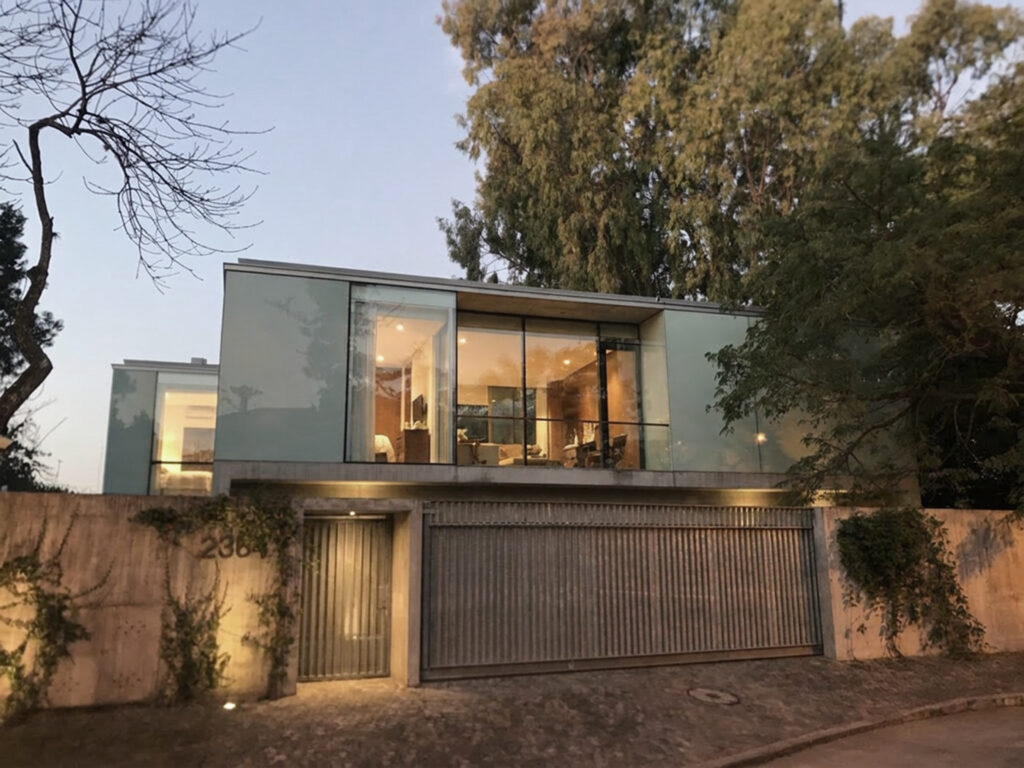
I’ll give you an example from my own career, my first big project. Fresh out of school, I had to design eight luxury homes of three hundred square meters each, with direct access to the Río de la Plata, on a plot constrained by a very tight FOS (Factor de Ocupación de Suelo — the site coverage ratio, for anyone who doesn’t know), where, on top of that, we couldn’t build enclosed boundaries between the houses. The answer was to design internal courtyards: they brought sun, light, and cross-ventilation into every room, created a direct relationship with the vegetation from the heart of each house, and made them feel bigger without counting toward the FOS. But here’s the interesting part: those extra forty square meters per courtyard became private space, which meant we could sell an additional forty square meters per unit. A single architectural decision improved quality of life across six or seven different dimensions and, on top of that, increased the development’s profit by fifteen percent. That’s what I mean by culture and efficiency working together: it’s not about choosing between what makes better architecture and what’s more profitable, but about finding the decisions that serve both.
And the cultural dimension? How much weight does place carry in a design decision?
It carries everything. I think the problem with a lot of contemporary architecture is that design has won out over culture. Algorithms, social media, renders — everything pushes toward a global, flattened language, where a building in Dubai could just as well be in Buenos Aires or Singapore without much changing. To me, that’s an impoverishment. Again… these are conversations and debates that go back a long way, very strong with the theorists of the Industrial Revolution… then in publications like De Stijl… or at the Bauhaus, and more recently in the “international architecture” of the great postwar masters…. Put simply: good architecture breathes the place where it’s planted. It looks at local materials, local light, local customs, the history of the neighborhood, if it’s urban…. So that the building is in dialogue with its surroundings, with its culture, and through that, also in dialogue with the people who are going to live in it, without flattening them. Again, this is pure business: people buy emotion, they buy belonging, they buy history. A building that converses with its place is worth more, sells better, and is loved more. Culture isn’t decoration: it’s an economic asset, even if the balance sheets don’t measure it that way.
Behind every architect there’s a team. How much weight do partners and investors carry?
They define almost everything. With good people, projects fly: the tests — which always come, that’s not optional — get faced with judgment, with composure and speed, and first-rate partners put themselves at the service of the work, not the other way around. But there are also harmful investors, the ones who aren’t thinking about the project but about how to get an edge over the person next to them. Those can hold up a project for years, and even sink to moral lows that are pretty hard to digest, just to come out ahead. I’ve seen spectacular projects stalled by one partner’s pettiness, and impossible projects unblocked in a single afternoon by a team that decided to row in the same direction. Since everything is learned on the job, there are very good people out there, and very ugly ones too. That’s why we try to choose partners with the same care we choose a material for a building: by character, by the consistency between what they say and what they do on small matters, and by how they age under pressure. Architecture is a team sport. Without a good design and business team rowing in the same direction, not even the best design reaches port.
Your role at the AIA has you traveling quite a bit. What are those trips leaving you with?
A lot, and it’s hard to process once you’re back. The American Institute of Architects’ international conferences pushed me out of my own mental map. I’ve been to Dubai, Hong Kong, London, and Mexico, among others, walking through entire cities with colleagues I admire. Dubai confronts you with scale, with speed, and with uncomfortable questions about sustainability and identity. Hong Kong is a lesson in density and in how the vertical, when well resolved, can be deeply human. In Mexico, for example, I had an unforgettable walk with Jacob van Rijs, of MVRDV, the Dutch studio — not only an eminence but someone I looked up to when I was a student. Walking around a city for several days with someone at his level is a masterclass in motion: you trade ways of looking at facades, which details catch the eye, how what they’re seeing connects to urban problems in their own culture or on a global scale. You realize a trained eye never stops working, never rests. Each of those trips left me with a notebook full of sketches and the conviction that there’s good architecture on all five continents, much more widely distributed than the social-media algorithm wants to show us. You come back with a clean eye and the certainty that this craft is enormous, and that you’re still learning, no matter how many years of practice you have behind you.
You’re also writing. What’s that paper you’re working on?
I’m putting together a text that traces the path of SANO, our studio — the decisions that shaped us, the projects that defined us, the successes and also the mistakes that taught us the most. And within that framework there’s a concrete proposal for rural social housing in Argentina. It’s a piece of work that mixes the three things that interest me most: business, architecture, and a genuine social-approach. Rural Argentina has an enormous housing deficit and, at the same time, an immense cultural and scenic wealth that’s being underestimated by public planning. The question is how to design replicable typologies that are economically viable, architecturally dignified, and socially transformative, without falling into either misguided charity or pure hard-nosed business. How to use materials from the area, how to involve local labor, how to think about a financing model that can scale without losing quality. I’m convinced it can be done, and that these are the kinds of projects that justify many hours at the drafting table. When it’s ready I’ll share it, because the idea is for it to be an open resource and to invite others to discuss it, criticize it, and improve it.
Let’s talk about Pueblo Punta Ballena, recently mentioned by Forbes Uruguay. What’s coming up there?
Pueblo Punta Ballena is one of those projects where you can feel a lot of things converging at once: landscape, Uruguayan culture, international demand, a human scale, a history charged with mystique. The Forbes Uruguay piece put the spotlight on something we’d been building quietly, and the truth is a really good new stage is coming. We’re working in layers: urban consolidation, the addition of new architectural pieces that respect the spirit of the place while also projecting it into the future, and a commercial proposal aligned with a buyer profile that increasingly values uniqueness over generic luxury. Punta Ballena has an unmistakable identity, shaped by its pioneers and by a privileged geography, and the opportunity is enormous if you approach it with respect and patience. What’s coming excites me a lot, and I think it speaks to Uruguay’s coastal development, which has a very rich history and architecture, showing that you can grow without losing your soul.
And in Buenos Aires there’s the Ara Homes series. What stage are you at?
Ara Homes is a venture that blends landscape, architecture, and business in the heart of Palermo. The first building was a success on every front — commercial, architectural, and in terms of user experience — and that gave us the energy and the legitimacy to take on a second building, which we’re launching now. It’s a major investment, with a very clear vision: bring vegetation into the center of the city, create spaces that breathe, bring in natural light and noble materials, and do it all with an economic rationale that justifies its scale. The first ARA tested the hypothesis; with the second, we’re aiming a step higher, adding concrete lessons from the first one and raising the quality of the common areas and finishes. I think it’s going to work very well, which is hard to pull off in a market that often rewards the shout over the whisper. To me, Ara Homes is living proof that architecture, landscape, and business, when they work together from the first sketch, generate much more value than when they’re thought of separately.
What influences shaped you, and what new voices are you following today?
My influences come from very different worlds, for anyone who wants to dig in…. Antonio Bonet, a Catalan who found a unique balance between poetry and practice on the Río de la Plata. Amancio Williams, with his Casa del Puente. Brazilian architecture, from São Paulo and Rio, a masterclass in how to engage with climate and landscape. Alvar Aalto… so many… And the Japanese constellation, from Kenzo Tange to Tadao Ando, Sou Fujimoto, Kengo Kuma, Ryue Nishizawa, Kazuyo Sejima. The Uruguayan school, less for specific names than for its whole feel… full of poetry. And, thanks to the AIA, an enormous wealth of African and Asian studios that were practically absent from my university education. What I want to underline, above all, is that interesting new voices keep appearing, all the time. Voices that are hard to find amid today’s mass communication, where the algorithm amplifies what’s already known and buries what’s emerging, rewarding repetition over searching. But they’re there. They’re always there. They show up in small studios, in countries that rarely make a magazine cover, in three-person offices doing work that in ten years we’ll all be citing. Discovering them in time is part of the craft: it takes traveling, reading independent publications, listening to colleagues on other continents, going to talks that don’t draw crowds, and being a little suspicious of your own bubble. The good architecture of the next century is being cooked up, right now, in places no mainstream feed shows you. And part of my professional enthusiasm comes, precisely, from continuing to look for them.
If you had to leave a message for a young person entering the profession, what would it be?
Study, travel, look at everything, draw by hand, do internships to get into a good studio, and learn to read people as well as you learn to read a site. Understand that architecture is a long craft, built with patience and with well-chosen partnerships, and that the decisions you make today will define what kind of professional you’ll be twenty years from now. Don’t get seduced by trends or easy renders, or by the temptation of a quick project with shady partners: the cost, sooner or later, gets paid, and it’s almost always paid more dearly than expected. And above all, take care of your voice. Your own voice is the one thing you can’t buy, and the one thing that, in the end, sets one professional apart from another. Of course, finding it is a long process… if not a constant one. Trends pass, algorithms change, tools get replaced. Your voice, if you cultivate it honestly, stays. Architecture, like art, demands truth. And truth, in business, is called integrity. When art, culture, and profitability align in the same decision, the work stops being an object and starts being a legacy. That’s what’s worth dedicating a life to.

www.lisandroaloi.com
www.sanoara.com


